
The Natural Complexities of Family Business
When Two Worlds Collide
When business meets family, something remarkable happens, and something remarkably complex. In our last newsletter, we explored governance as “Leadership made visible”. Now let's talk about why that intentional leadership matters so much: because family enterprises operate at the intersection of two fundamentally different systems, each with its own logic, rhythms, and needs. Understanding the aspects at play enable us to navigate the natural complexities in a way that is good for the family and for the business. After all, great outcomes are when each individual is happily thriving in their own right, none are left behind and the family business or enterprise is flourishing!
The family business sits at a unique intersection, where love meets logic, where dinner table conversations can drift into strategic planning, and where the people you've known since birth become your business partners. It's a beautiful complexity, though complexity creates unique challenges and is not simple. When these conversations lack clear boundaries, even the strongest relationships can strain under the weight.
These two systems, family and business, operate on fundamentally different principles. Family is about unconditional belonging, nurturing, and emotional connection. Business requires performance, accountability, and sometimes difficult decisions based on capability rather than relationship. When these worlds overlap without clear boundaries, a layer or two of unspoken assumptions and expectations, confusion follows.
Consider the different rhythms at play: a short time in family life is a long time in business. Your business strategic plan spans 7–10 years. In that same period, your child grows from 7 to 17 and is likely still far from demonstrating much interest in the business, while also lacking the emotional maturity to genuinely understand it. The business needs strategic intervention while the child is assuming the business that has always been there, “their family’s business”, will always be a core part of the family’s identity.
The family business is not the family nursery. This isn't about being harsh, it's about being clear. The business needs to thrive on its own merits, with decisions made for business reasons. The family needs space to be a family, without every relationship filtered through business dynamics. When these boundaries blur, neither system functions optimally. Business decisions made today will shape the family’s landscape and visa versa! Both of these systems need consideration independently and at the same time, with understanding of the implications and consequences they create in the other. It’s a find blend of operating separately and cohesively at the same time.
The challenge isn't eliminating the complexity, that's impossible and probably undesirable. The challenge is navigating it with intentionality. Creating pathways where each individual happily thrives, the family bonds stay strong, and all alongside the family enterprises achieving what the family desires.
.png?width=948&height=606&name=SHW%20Banners%20(10).png)
Understanding Where the Complexity Lives
So how do successful family enterprises navigate these natural tensions? It starts with understanding where the complexity actually lies.
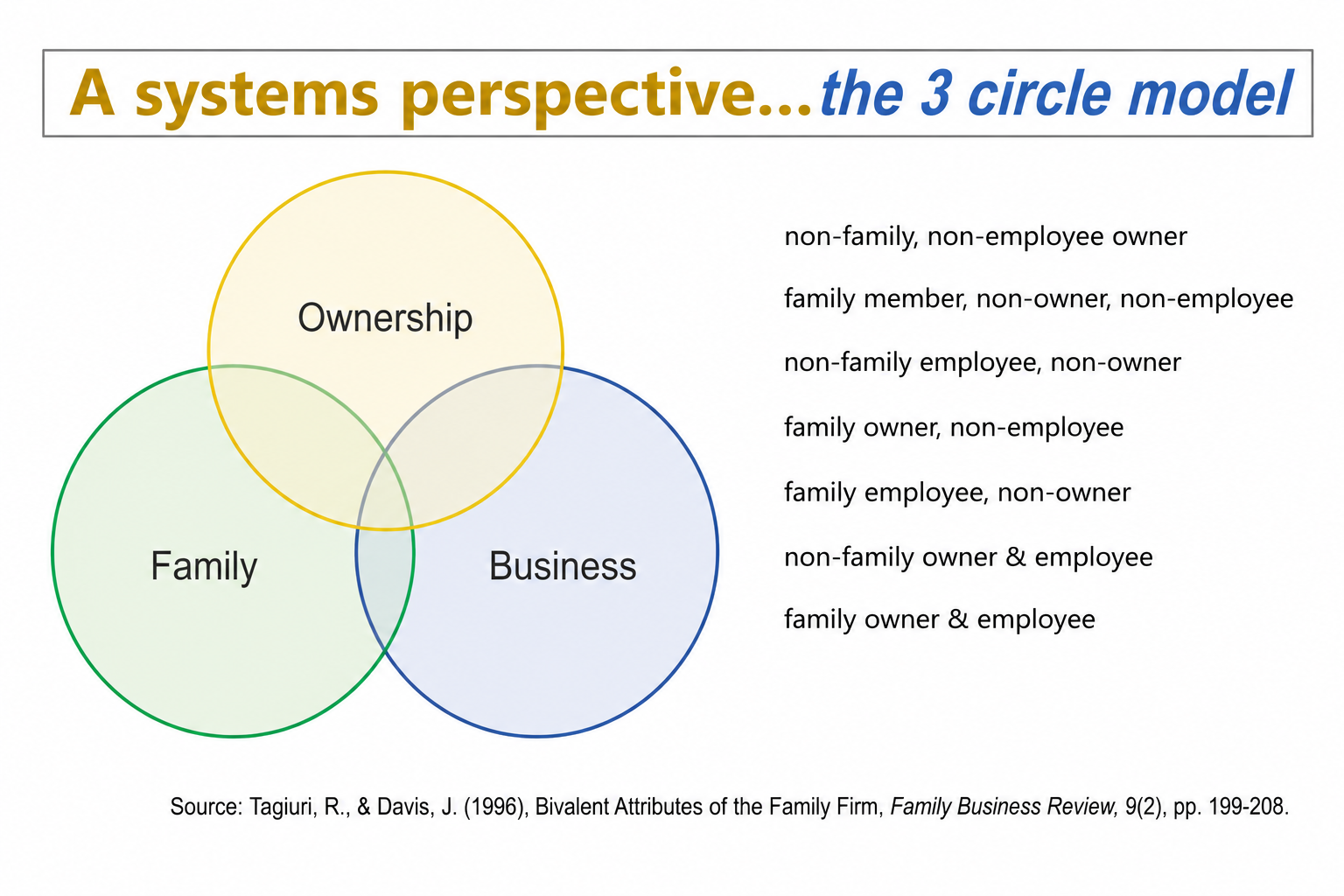
Imagine you, your siblings and adult children. You all have different personalities: some of you feature in shareholder agreements, some appear on the business org chart, and others of you simply enjoy hanging out at the extended family holiday. This is the reality of a family with business or business enterprises. The three-circle model (see below) goes some way to depict this, and just as it shows us the overlaps, it by definition shows the complexities and nuances where each position comes with different perspectives, different stakes, and different needs.
These differing yet overlapping circles have natural rhythms of their own... add in overlapping and it can get tricky!
How do these three overlapping circles: Ownership, Family and Business play out? Here are some examples: Your sister who owns shares but doesn't work in the business verses your brother who works there but doesn't own any shares yet. And your cousin who's both an owner and employee, different again.
Picture the family member who owns 20% but works 60-hour weeks sitting across the Christmas table from a sibling who also owns 20% but hasn't set foot in the office in years. Same ownership stake. Completely different lived experience. Clarity about what each position means, finding some shared understanding on what fair is from each perspective and having some robust conversations are vital if long term conflicts are to be avoided.
Take a moment: which circle(s) are you standing in right now? And do the other family members in your enterprise understand your perspective from that position? Do you understand theirs?
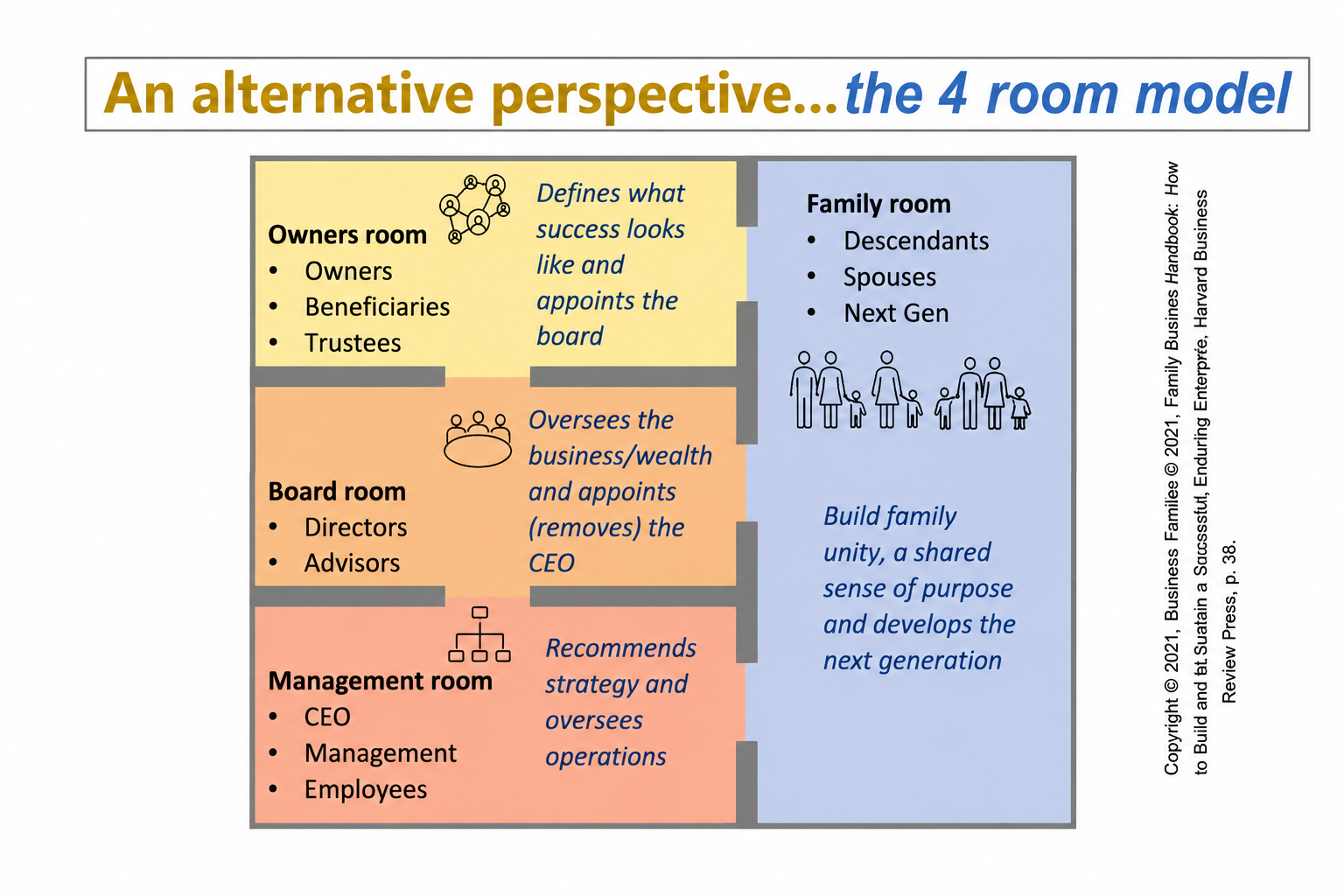
Another way of viewing the situation is using what's called the 4 room model, which shows owners, those responsible for business decisions and operations, and the family room, all rooms where at any given time a person may be occupying. Knowing where you are and who you are representing at any point in time is important. Is celebrating a family issue in the midst of a management meeting the best use of your managers' time? Maybe, maybe not.
The Family Room is a vital space for families. This is where spouses, the next generation, and extended family build unity, develop a shared sense of purpose, and prepare the next generation. Not for immediate business involvement, but for eventual stewardship. Don't let this incredibly valuable room get overlooked.

Heritage To Horizon Podcast: Conversations That Matter
We’ve officially wrapped the first 2026 season of the Heritage to Horizon podcast. This season explored what governance really is (and isn’t), the natural complexities that arise when business is personal, and the balance required for both family enterprises and the individuals within them to thrive.
Across the season, we shared thoughtful conversations with voices from across the family enterprise landscape—exploring governance beyond the boardroom, stewardship versus ownership, the role heritage and storytelling play in shaping identity, philanthropy as a tool for connection and legacy, and what intentional leadership looks like across generations. Each episode was designed to go beyond surface-level business conversations and offer practical wisdom, fresh perspectives, and meaningful reflection for families building lasting legacies.
If you’d like to catch up on the season, you can listen to all episodes on Spotify and Audible linked below.
We've talked of governance before, framing it as leadership made visible. These overlapping circles and different rooms reiterate why intentional leadership at a family level matters just as much as rigorous business decision-making.
I've sat with families where brilliant, capable people who genuinely love each other find themselves completely stuck. Not because anyone is doing anything wrong, but because they're each standing in different circles with different views of what's fair, what's needed, and what success looks like.
The board meeting where the strategic discussion derails because someone brings up their sibling's work-life balance. The family dinner that turns tense when business comes up. The next generation member who's working flat out but feels invisible. The owner-sibling who carries none of the operational load but has strong opinions about every decision. The important conversation you keep putting off because you're not sure how to start it without creating conflict.
Sound familiar? These aren't signs of dysfunction, they're the natural result of operating across multiple circles without clear frameworks.
In our next newsletter, we'll explore how families create the clarity and boundaries that transform these dynamics. In the meantime, if any of this resonates, feel free to get in touch. Always happy for a quick chat.
Until next time,
Sandy